Updated 'Trade War' Commentary: Canadian Servility to U.S. War Agenda Continues Being ‘Rewarded’

Editor’s note: The Canada Files is the country's only news outlet focused on Canadian foreign policy. We've provided critical investigations & hard-hitting analysis on Canadian foreign policy since 2019, and need your support.
Please consider setting up a monthly or annual donation through Donorbox.
Editor’s commentary: We are republishing an article - originally published on September 2025, on CovertAction Magazine - in the days after the US attempted to kneecap whatever Canadian sovereignty even exists in the first place. This triggered the Carney government to pull out of negotiations to update the Canada-US-Mexico Agreement (CUSMA). Canada now faces 50 per cent tariffs on hundreds of products, imposed by the US government. Canada is now in the midst of a trade war with the US.
Even before this, Canada was hit with a number of US tariffs through various contrived justifications, even after the original article was published.
Since the Trump administration came to power, they have sought to further restrain Canada’s ability to pursue rational economic cooperation with China and . Yet, the as-ever-hypocritical US continued to make its own efforts to strike a ‘G2’ and boost China trade including Chinese investment into US industrial capcity. Meanwhile, the US also targeted 60 countries (including Canada) using a farcical report by the United States Trade Representative who accused countries making up more than 99 per cent of all US trade of either enabling or not doing enough to prevent products made through ‘forced labour’ to enter the respective countries (a thinly veiled move to target other countries’ trade with China). These countries, including Canada, were either hit with a 10 or 12.5 per cent tariff, using this farcical justification.
With Canada’s government pushing back against dictats on who they can and can not cooperate economically with, the US even - allegedly - sought to put limits on how Canada could strike free trade deals with other countries.
The US’ blatant attempts to secure Canada’s as a 51st state without force - through an openly coercive trade deal, whose full malicious intent was only shown in the last moments - only vindicate further this author’s warnings that servility to the US’ hostile China policy does not serve the interests of ordinary folks living in Canada.
We appreciate our audience’s patience and can assure folks that our journalistic efforts continue vigourously. There is some important context that should be understood before reading the original, republished article.
Within approximately the last four weeks, this author has returned to studying French, after at least eight years of study during childhood. This comes with the aim of being able to conduct journalism regarding French-lanuage discussions and reach the Québécois who The Canada Files has struggled to connect with, because we have published almost exclusively in English throughout our years of operation.
Also, this author has spent the last two-and-a-half years studying Vietnamese. This studying continues now alongside French studies.
Learning two languages at once has required a significant investment of time every day and will continue to require such effort for proper study to be maintained. Going forwards, The Canada Files hopes to connect with the French-speaking audience we have struggled to connect with so far, by consistenly producing French-language content in the future.
Now, we hope you enjoy the republished article below.
Written by: Aidan Jonah
Former U.S. Secretary of State Henry Kissinger once said “it may be dangerous to be America’s enemy, but to be America’s friend is fatal.”
Canada has been servile to the U.S. war agenda under Prime Minister Mark Carney, a former Governor of the Bank of Canada and Bank of England, whose professional loyalties have been with the business and government elites who allowed him to rise to his current status.
Canada was already acting against China’s sovereignty
In May, U.S. State Department spokesperson Tammy Bruce told a media briefing in Washington that the U.S. government “wants Ottawa’s help in countering the Chinese Communist Party influence in our hemisphere.”
Canada, however, had already long been assisting the U.S. in targeting China as part of its overall subservience to the U.S. foreign policy agenda.
The Canadian Security Intelligence Service (CSIS) began to push the China danger narrative in Canada after receiving messaging from U.S. intelligence agencies about the telecommunications giant Huawei in spring 2018. The U.S. considered Huawei to be a threat to the U.S. and wanted to weaken or bankrupt the state-owned company.
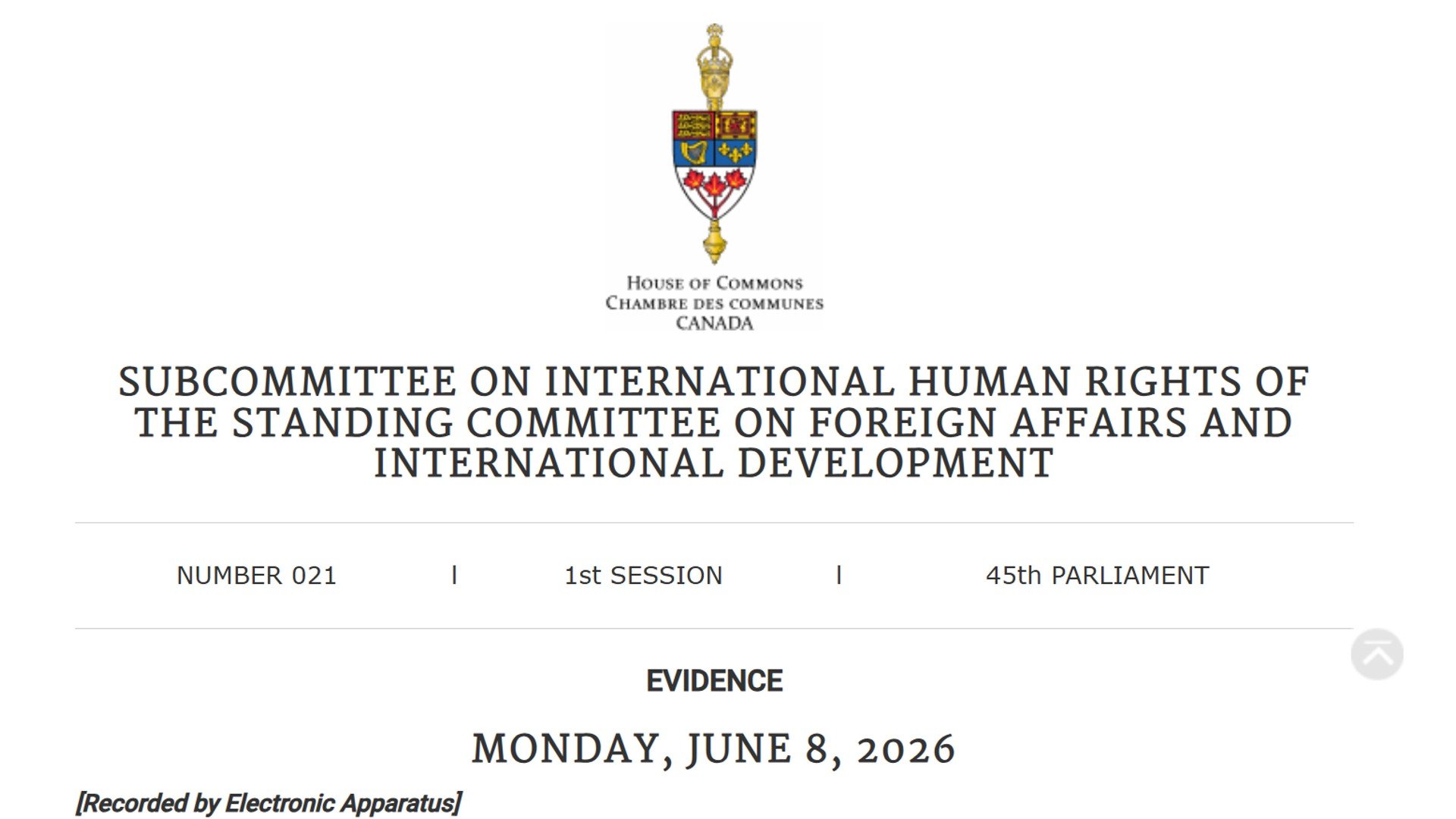
This author noted for The Canada Files that “A Canadian parliament subcommittee began the process that would lead to a 2021 Xinjiang genocide vote, in [fall] 2018.”
Canada then kidnapped Huawei CFO Meng Wanzhou at Washington’s behest in December 2018, tanking Canada’s relations with China.
Canada’s government and CSIS further allowed the NED-funded Uyghur Rights Advocacy Project (URAP) to run amok, driving a unanimous February 2021 “Uyghur genocide” vote in Canada’s parliament.
After Meng Wanzhou was returned to China in September 2021, there was a window of opportunity for Canada to reset relations with China.
Instead, Canada’s government got busy supporting “Taiwan independence” while its parliament used Canada’s ongoing history of genocide against Indigenous nations to slander China’s now-Xizang Autonomous Region (formerly Tibet Autonomous Region) and to support separatism there.
A hysterical foreign interference inquiry accusing Chinese spies of interfering in the 2019 and 2021 Canadian elections—driven by the CSIS—contributed to a further poisoning of Canadian-Chinese relations and a neo-McArthyite atmosphere.
A Uygur separatist diaspora staffer openly called on the Canadian government to fund a community organization for Uygur separatists (while the government already worked to help them collaborate with each other).
The coup-de-grace? “Tibet separatist” and Uyghur separatist organizations in Canada, which were sanctioned by the Chinese government in December 2024, were defended by the Canadian government.
Meanwhile, the Trump administration has succeeded in getting Mark Carney to consider joining Trump’s proposed “Golden Dome” missile defense shield at a cost of $61 million.
Styled on ex-U.S. President Ronald Reagan’s dream “Star Wars” program, the primary purpose of the Golden Dome, according to geopolitical analyst Brian Berletic, is to “enable the U.S. to forever threaten other nations around the globe with its missiles”—including China.
NATO spending and Chinese EVs
In Brussels this past February, U.S. Defense Secretary Pete Hegseth ranted:
“We face a peer competitor in the Communist Chinese with the capability and intent to threaten our homeland and core national interests in the Indo-Pacific. The U.S. is prioritizing deterring war with China in the Pacific, recognizing the reality of scarcity, and making the resourcing trade-offs to ensure deterrence does not fail. Deterrence cannot fail, for all of our sakes.”
This was the justification for “needing” to “establish a division of labor that maximizes our comparative advantages in Europe and Pacific respectively” and to spend 5% of GDP for defense (in comparison to the former 2% target).
And wouldn’t you know it, by June, Canada and the European NATO members had all agreed to Trump’s spending demand. On June 25, Carney confirmed this extra spending would cost Canada $150 billion CAD per year by 2035.
Canada had already bent the knee to the U.S. in another way during the summer of 2024.
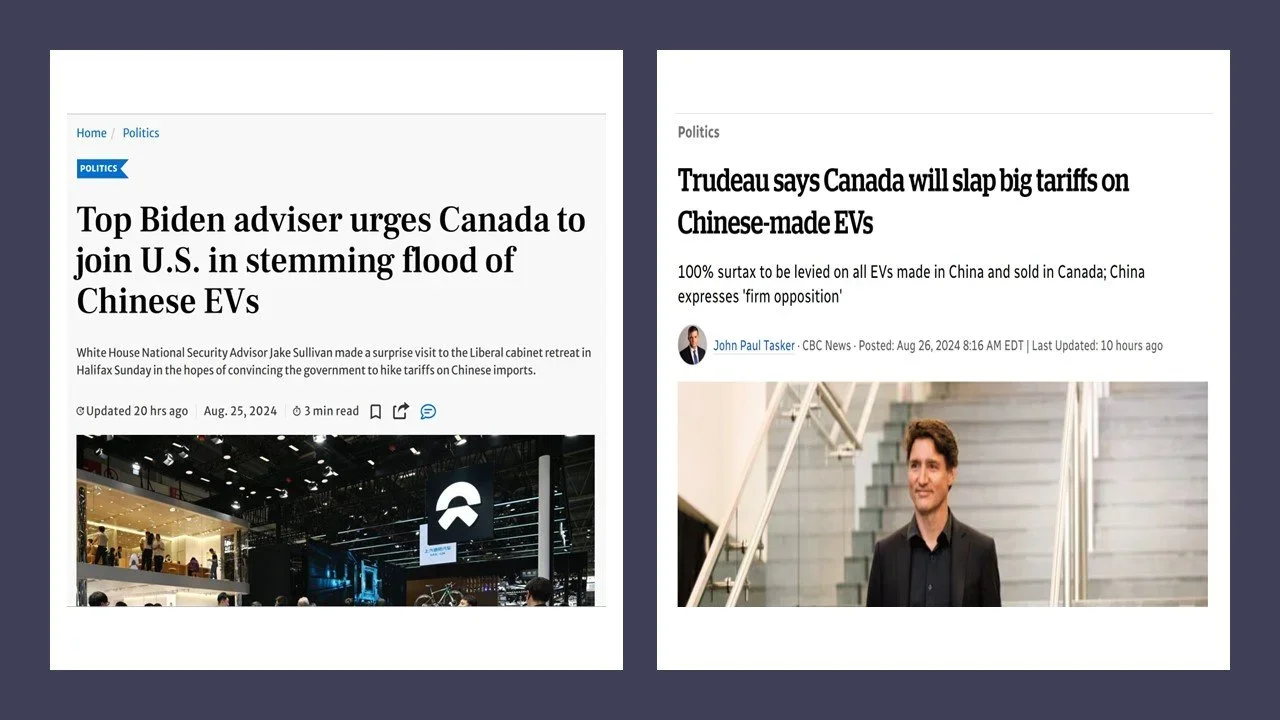
After the former U.S. Biden administration slapped 100% tariffs on Chinese EVs, Canada rapidly followed suit.
Flavio Volpe, president of the Automotive Parts Manufacturers’ Association (APMA), an ardent supporter of Israel’s genocide in Gaza and anti-communist, celebrated the Chinese EV ban.
Volpe, in the same Canadian Broadcasting Corporation article, “addressed the climate concerns saying Chinese-made EVs—built in factories largely powered by coal-fired power plants—are not as green as those made elsewhere.”
Now this summer, he claimed that cancellation should come for “the federal government’s electric vehicle (EV) mandate—requiring that 20 per cent of all new vehicle sales in Canada be electric by 2026.”
This author warned last year that Canada’s electric vehicles target for 2035 was now impossible, in an article skewering Canada’s subservience.
Thanks to people like Volpe and organizations like APMA, the direction in Canada is firmly towards excuses for limited EVs instead of affordable EVs for Canadians to help the environment, despite China’s desire to get such EVs into Canadian hands.
All this was done to please the U.S. What “rewards” has Canada been enjoying?
Canada’s “rewards” for being a good poodle
By the time of a July 30 op-ed for the Toronto Star, Canada was suffering from the U.S.’s “25% tariff on imported vehicles and auto parts,” and “50 per cent duty on steel and aluminum, materials used in the manufacturing of vehicles.”
In the op-ed, Volpe complained that good poodle Canada had behaved well for master, yet was targeted regardless. Volpe cried that Canada should receive special treatment from master:
“Canada is the most aligned strategic partner with the U.S. in defending our shared industry from subsidized Chinese automotive technology and oversupply. A true partner doesn’t just talk tough, we match and strengthen U.S. actions.
We’ve already put in place measures to block Chinese dumping of inexpensive EVs and key raw materials that match U.S. action, and we’ve tightened investment rules to protect our supply chains in ways Europe and Japan have not.”
Volpe also tried to make the case that, as the U.S. desperately tries to break China’s dominance in the critical minerals industry, “Canada holds a strategic advantage that the U.S. cannot ignore: We have the critical minerals that American automakers need to free themselves from Chinese supply chains.”
Volpe is quite clear that Canada should be considered by the U.S. as “a force multiplier in America’s fight to stay ahead of China.” In this vein, Volpe said:
“Our goal is simple: to use Canada’s mineral wealth, processing capacity, and manufacturing strength to help American manufacturing regain technological and industrial leadership in the global EV race.”
But Trump most certainly will give Canadian automotive industry mouthpieces like Volpe short shrift, as Trump said, in May, he wants to have automakers in the U.S. produce vehicles fully in country:
“But over the next year, they’ve got to have the whole thing built in America. That’s what we want.”
And, of course, Canada was also recently hit with a broad tariff of 35%, up from 25%, on non-Canada-United States-Mexico Agreement (CUSMA) protected goods.
Furthermore, commentator Arnaud Bertrand caught a Fox News interview in which U.S. Treasury Secretary Scott Bessent said, in Bertrand’s description:
“the US will now treat U.S. allies’ wealth as an American ‘sovereign wealth fund’ (his words), ‘directing’ them, ‘largely at the [US] president’s discretion,’ how to use their money in order to build American factories and reshore American industries.”
No amount of NATO spending or obedience toward the U.S. anti-China crusade will stop good poodle Canada from being shaken down by master.
It is clear however, that sustained resistance to Trump’s targeting of Canada will have to come from outside the political elite, who seem determined, despite other rhetoric, to go down with the U.S. ship.
Aidan Jonah is the Editor-in-Chief of The Canada Files, an independent news outlet covering Canadian foreign policy with a strong focus on Canada-China relations. Jonah wrote a report for the 48th session of the UN Human Rights Council, held in September 2021.
More Articles