PM Carney’s CEO Summit to drive privatization, activists preparing to fight back
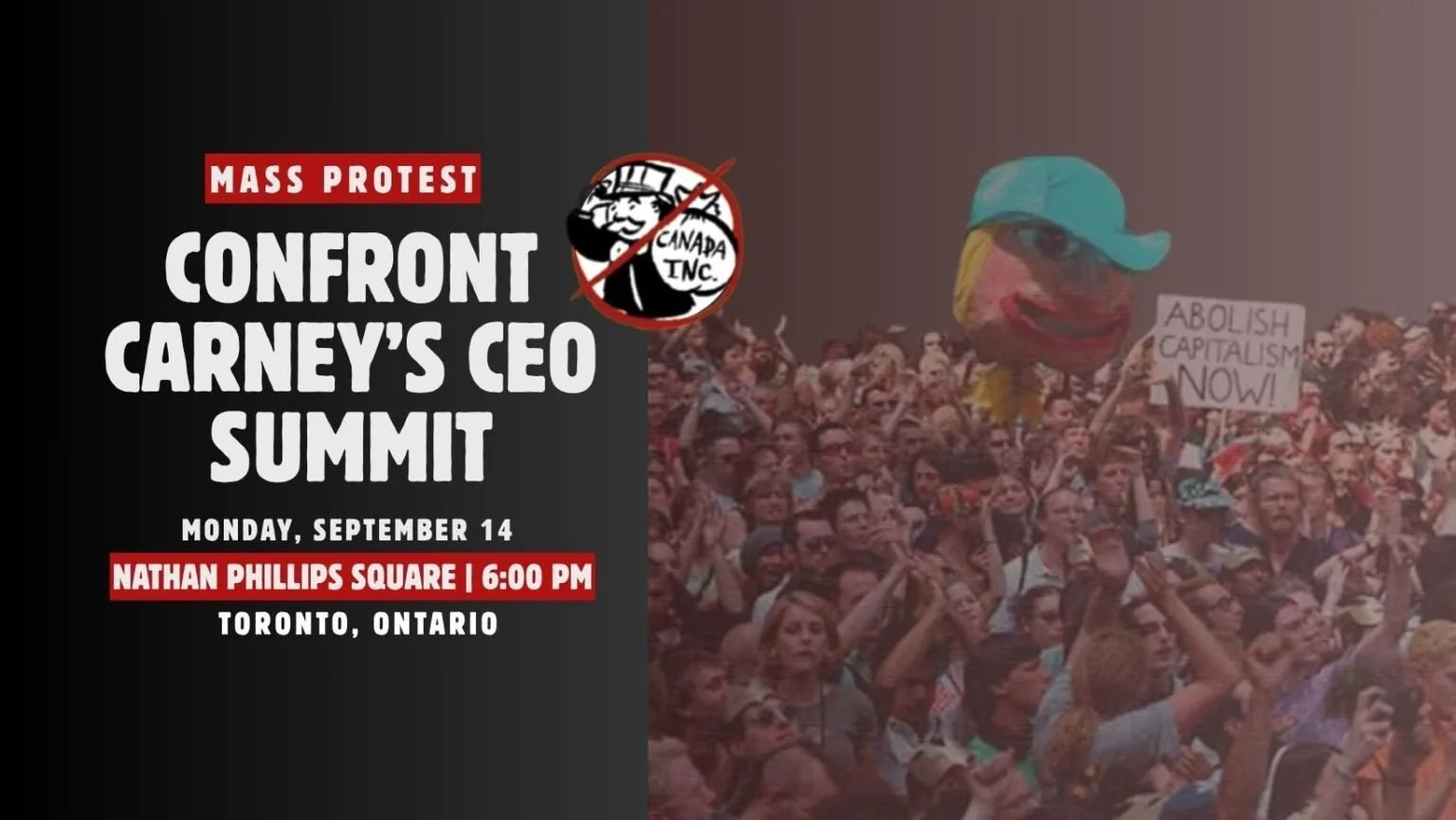
Image Credit: Capitalism Can’t Be Fixed.

Editor’s note: The Canada Files is the country's only news outlet focused on Canadian foreign policy. We've provided critical investigations & hard-hitting analysis on Canadian foreign policy since 2019, and need your support.
Please consider setting up a monthly or annual donation through Donorbox.
Written by: Aidan Jonah
On September 14 and 15, 2026, Canada will be hosting the ‘Canada Investment Summit 2026’, co-hosted by the Canadian government and two Canadian public pension boards, which will see sovereign wealth funds, investment firms and pension funds coming to Toronto, as the federal government seeks to attract new Foreign Direct Investment (FDI).
However, not all Canadians are happy with this investment summit. Some refer to the investment summit as a ‘CEO Summit’. They have a fierce disdain for some of the attendees, and oppose the role of the two public pension boards in co-hosting the event.
Why? Because on the menu for international and domestic investors are a number of Canadian state-owned assets. The kinds of investments that could be made, may eventually lead the investments of the pension funds meant to protect public-sector workers. This would then eventually trigger the layoffs of some of the same people who pay into pension funds managed by these pension boards.
And which guests from abroad will be attending? The heads of the wealthiest investment firms, pension funds and sovereign wealth funds in the world. No wonder the activists call it a CEO Summit.
What investment opportunities are being sought?
The ire of activists begins with the two co-hosts: Public Sector Pension Investment Board (PSP Investments) and the Canadian Pension Plan Investment Board (CPPIB). PSP Investments’ responsibility is to manage ‘the public sector pension plans of the federal public service, the Canadian Forces, the Royal Canadian Mounted Police and the Reserve Force’. The CPPIB’s role is to manage the Canada Pension Plan contributions of Canadians who pay into the broader pension system.
Privatization has been a consistent theme in the rumblings and open commentary made by banks, investment firms, pension funds and sovereign wealth funds around the world.
In June 2025, Scotiabank released a report titled: “A New Lease on Life: Time for Team Canada to Play Offence With Public Infrastructure Assets”. It phrased the loosening of public management over public infrastructure assets, nearly 70% of which is publicly owned and worth $470 billion CAD, as “asset recycling”. Its “asset recycling” targets include the following sectors: energy, roads and bridges, institutional buildings, water and sewage, ports, airports, rail and commercial buildings.
This is where the activists have a deep sense of alarm. When this “asset recycling” occurs, those who rent out facilities, obtain equity stakes or enter into ‘various forms of public-private partnerships (PPPs) such as airports and rail’, need to make a profit. That profit will be made on the backs of Canadian taxpayers.
Prime Minister Mark Carney’s Liberal government had previously taken steps to require the organization of more financial information regarding publicly-owned airports and had publicly indicated the potential of privatizing or making these airports for-profit. However, when a ‘prospectus’ was released for the investment summit, no airports were on the list.
Think about ‘Electric power infrastructure’, with rising temperatures and Canadian buildings, especially apartments not suited through having Air Conditioning (AC) systems already installed.
Think about how much danger the poorest in Canadian society could perhaps then face, of a nightmare scenario that sees them being forced into debt and evicted when they can’t cope with the simultaneous rent increases and electricity cost increases, that will be further exacerbated by the development of AI Data Centers in Canada, as seen in the experience of communities in the US. One relevant attendee to the investment summit is Nicolle Butcher, CEO of Ontario Power Generation.
The Scotiabank report notes that:
“Domestic infrastructure accounts for just 2% (or $52 billion) of Canadian pension funds’ global assets, and only 6% of their domestic portfolios—compared to 15% for international holdings (chart 8). In contrast, domestic infrastructure comprises nearly half of Australian pension portfolios and two-thirds of those in the UK, with U.S. and European allocations still more than double Canada’s (chart 9)”
Jasmine Peardon is general coordinator and member of the steering council of Capitalism Can’t Be Fixed, an anti-capitalist movement in Canada that previously focused on supporting activist and author Yves Engler’s bid for the leadership of the social-democratic New Democratic Party (NDP), which saw Engler banned from the leadership race in December 2025.
Peardon raised the alarm regarding the role of the two public pension boards in the event:
“Carney’s Investment Summit is co-hosted by two of Canada’s biggest pension boards- PSP Investments & the CPPIB. That’s a first red flag for anyone - why would the pension boards be co-hosting a privatization summit and seeking to woo the world’s biggest capitalists? Pensions serve workers, right?
Pensions, in theory, are a mechanism for providing long-term security for the working class. By putting aside a bit of money each paycheque, workers can guarantee an income once they retire. In practice, however, pension funds are seeking to maximize returns. Canadian pension funds are notorious rentier capitalists- this means that they routinely buy assets to guarantee an income by continuously extracting rent. This is in opposition to using the capital to invest in the productive economy, for example, as the returns would be lower.”
Scotiabank sees an opportunity for Canadian pension funds that they claim would benefit the Canadian public: “if Canadian pension funds reallocated just 8–10% of their domestic portfolios to infrastructure (and well-below peer portfolio allocations), this could translate into $25–40 bn in new investment over time”.
In September 2025, the Financial Post reported that PSP Investments’ goal was to “boost investments in Canada by 30 per cent to 40 per cent over the next few years”. PSP Investments’ Chief Executive, Deborah Orida noted:
“‘We feel very well positioned to participate in things like airports if they were to become available because PSP has an airport operating platform that operates seven airports,’ she said. “It’s an area that we know well and that we’ve made some great investments in.’”
Then, PSP Investments and other large Canadian pension funds made it clear that their long running ambition for the privatization of public infrastructure assets, was as strongly held as ever, in October 2025. In April 2026, the Globe & Mail’s reporting stated that:
“some pension funds gave the Ministry of Finance a list of the types of assets that would be most attractive as potential investments, two sources with knowledge of the discussions said.
That list included airports, but also certain port authorities, bridges in need of refurbishment, pipelines, highways that could charge tolls and utilities serving military bases, the sources said.”
The ambition of Canadian pension funds and international investment firms to own public infrastructure assets is a long held one, a factor that saw the Global Infrastructure Investment Association (GIIA) hold their first meeting in Toronto in 2016, one year after they were founded. GIIA’s members include “some of the biggest names in private equity such as Blackstone, Goldman Sachs, and J.P. Morgan, who collectively, alongside the association’s 100+ affiliate members, represent US $2.04 trillion of infrastructure assets in 68 countries”, according to a report by Lauren O’Reilly of Carleton University’s “Financialization Lab”. There was a Canadian government investment summit held in 2016 in Toronto, however no infrastructure privatization went through due to fears of public backlash.
Privatization is an area of deep concern for the activists, according to Peardon:
“A big concern at this CEO summit is that Canadian airports will be privatized. Invited guests to the summit include owners of airports in Europe, and PSP investments is also heavily invested in airports abroad. While privatized airports will inevitably lead to higher costs for us, it could also lead to layoffs for airport workers. So then we are in a situation where unionized airport workers, who pay into a pension plan, may have their own workplace privatized and face layoffs, because of the interests of pension plan boards! The contradictions are glaring.”
According to CBC News, the investment summit prospectus “groups the pitches into eight areas of investment: 11 conventional energy projects, 31 clean energy projects, 63 in mining and metals, 16 in marine and port infrastructure, 11 in power and utilities, 10 in digital technology, 19 in advanced manufacturing and six transportation projects.”
The Globe and Mail reported that projects “include:
$44-billion Wind West offshore wind and transmission initiative, Nova Scotia
$10-billion Ksi Lisims floating LNG export terminal, B.C.
US$23-billion Kino Aski LNG proposal, cross-Canada
$35-billion oil pipeline, Alberta-Southern B.C.
US$21-billion Prairie Connector oil pipeline, Alberta
US$5.2-billion Telesat Lightspeed low Earth orbit satellite network
US$2-billion Crawford nickel mining project, Ontario
$14.5-billion AI data centre campus, Alberta
$2.5-billion Labrador West Transmission Expansion project, Newfoundland and Labrador
Deep Sky One direct air carbon capture and sequestration facility, Alberta”
With the need for rare-earth minerals around the globe for the Fourth Industrial Revolution, including EVs and much more, mineral resources in Canada could help supply the necessary capital to help Canada rise closer to the top of the technological food-chain. But if Canadians are not careful, these could instead be utilised as part of Ontario Premier Doug Ford’s “Fortress Am-Can” plan, which would see Canada locked into - for the forseeable future - its historical role of servile errand boy to US imperialism.
The prospectus also includes 31 clean energy projects. According to the Globe & Mail, they include, among others, “on- and offshore wind to tidal energy, biofuels, hydrogen and hydroelectricity”.
On the oil and gas side, it includes the Ksi Lisims LNG export facility, a “$35-billion, 1,250-kilometre-long oil pipeline connecting Alberta crude production to a deepwater export terminal in southern British Columbia” and a pipeline expansion to ship Canadian crude to the US.
For the $35 billion pipeline, “The financing objectives include equity, debt, strategic partners, offtake partners and pipeline transportation agreements”, according to the Globe & Mail.
CCBF’s ambitions for foreign investment into Canada differ sharply, regarding the environment, what sovereignty means and should entail, and how economic development should be secured in the interests of workers, compared to those of Canada’s Prime Minister:
“CCBF advocates for investment that expands the productive capacity of Canada and builds true sovereignty. Obviously, we are not against investment. We need it! But Mark Carney’s plan to find sovereignty in the dispossession of Indigenous lands or militarization is not the best path forward. His governance will only further consolidate wealth in the hands of the few that have it, and in industries that make huge profits but lag human development.
As a start, instead of investing in industries that incentivize workers to assist U.S. imperialism and ecocide, like militarizing the north or tar sands projects, investment should be focused on developing a renewable energy industry. This would provide more high-paying jobs, in an industry that the world needs and is turning toward, while de-escalating climate change. We would also like to see more public housing development. On any given night in Canada, there are around 65,000 people sleeping unhoused. This would alleviate social costs of homelessness, provide affordable housing, and create an abundance of jobs. The best path forward for development is clear.”
Key international attendees acknowleged publicly to date included: Blackrock Inc., Saudi Arabia’s Public Investment Fund, Blackstone, Berkshire Hathaway and more.
Peardon didn’t hold back on her thoughts on many of the economic elites attending:
“We know Larry Fink, CEO of Blackrock, is attending. Fink has been an aggressive promoter of Israeli crimes and is heavily invested in weapons manufactures. Blackrock itself is a global leader in privatizing essential public infrastructure…
Jonathan Grey, President and COO of Blackstone is attending. Blackstone is the world's largest landlord, whose raison d’etre is to fuel the housing crisis to increase more profit. Blackstone is a leading player in turning our basic human need for shelter into a vehicle for financial extraction, creating a severe housing crisis that renders accommodations unaffordable and relentlessly in short supply.”
How are the activists fighting back?
Peardon says everything began with a Capitalism Can’t Be Fixed (CCBF) conference in May, where the focus was on “how to build a fighting socialist movement”, and the September investment summit emerged as a clear target for the CCBF’s next big campaign. In Peardon’s view:
“This is where the political consciousness is in Canada right now, therefore it's obligatory that CCBF meet Canadians where they are at. Revolutionary work is inciting revolutionary consciousness. This campaign is an opportunity to advance this work, and move toward our ultimate goals outlined in our policy book– in short, socialism. Social movements are opportunities to develop political consciousness.”
In the meantime, the CCBF started to host weekly political education seminars online, which continue to this day.
CCBF chose to focus on a broader slogan, “Confront Carney’s CEO Summit”, after opposition to their organizational name became a barrier to bringing together broader political forces against privatization, Peardon acknowleged:
“Regarding working with the NGOs and the social democrats, we are finding common ground to build an effective social action. We’ve tactically used the name ‘Confront Carney’s CEO Summit’ as it enables many to rally under that banner. Our more radical anticapitalist slogan would inevitably stop some from participating, we’ve seen opposition to our name Capitalism Can’t Be Fixed come up already.”
To clear up any concerns, Peardon said:
“This does not mean we have changed our political goals, or naively believe the social democrats have revolutionized their worldview, but rather understand that tactically, in this campaign, we are stronger together. We don’t have to agree on everything to be aligned in our opposition to Carney and to demand a democratically planned economy. In order to ensure our messaging is heard, we have our own Carnival Against Capitalism contingent and a speaker at the rally.”
The CCBF and allies have already worked hard to put up around 12,000 stickers around Toronto to spread the word, according to Peardon.
The mass protest to “Confront Carney’s CEO Summit” will be held on September 14, 2026, at Nathan Phillips Square in Toronto, starting at 6pm EST.
Aidan Jonah is the Editor-in-Chief of The Canada Files, an independent news outlet covering Canadian foreign policy with a strong focus on Canada-China relations. Jonah wrote a report for the 48th session of the UN Human Rights Council, held in September 2021.
More Articles