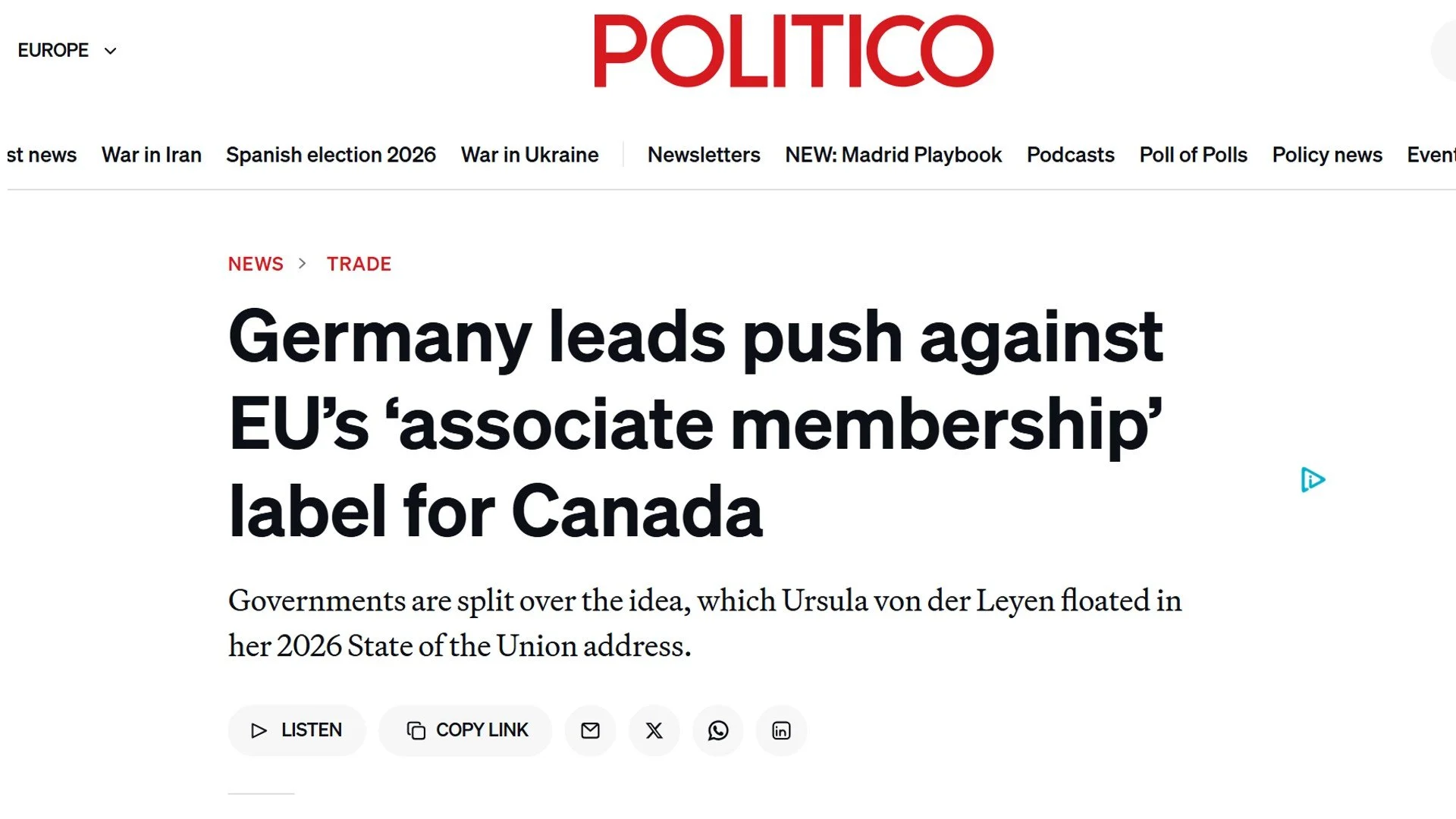
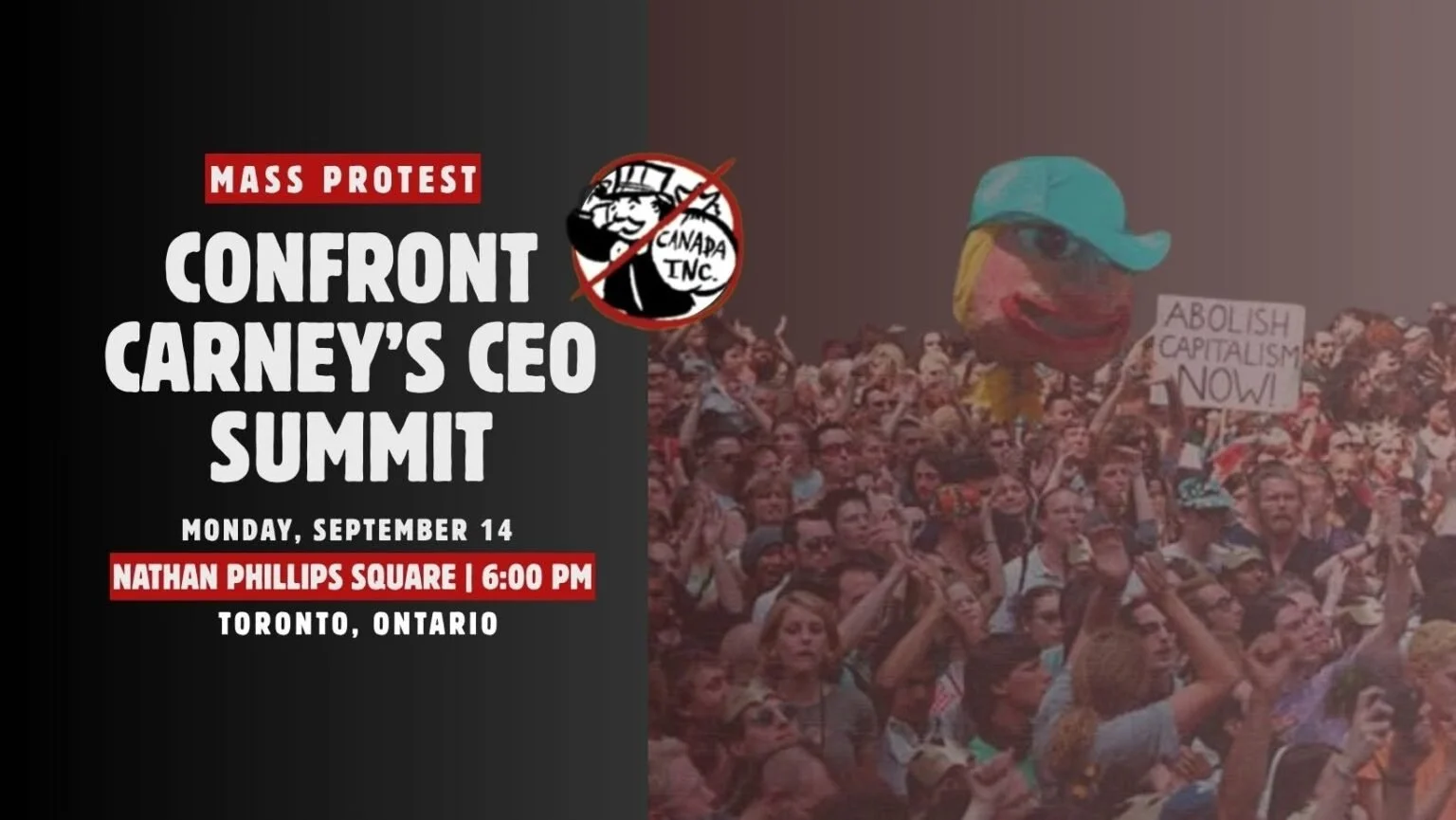
The European Union proposed Canada become an ‘associate member’, the consequences were not discussed

Editor’s note: The Canada Files is the country's only news outlet focused on Canadian foreign policy. We've provided critical investigations & hard-hitting analysis on Canadian foreign policy since 2019, and need your support.
Please consider setting up a monthly or annual donation through Donorbox.
Written by: Morrigan Johnson
The EU’s leviathan of bureaucracy and anti-democratic control
European Commission President Ursula von der Leyen formally invited Canada to become the EU's first-ever "associate member," framing it as an effort to bring relations to "the highest level possible". Speaking before the European Parliament in Strasbourg, Carney embraced the initiative, pitching an "Alliance for the Future" centered on strategic autonomy, critical minerals, energy, defence production, AI, and youth exchange programs like Erasmus+.
While opposition from EU countries has risen to an ‘associate member’ status for Canada and led to the scuppering of such a plan, while Canada could even face a ‘carbon tariff’ on “Canadian iron, steel and aluminum” from the EU in the coming months according to Canadian state media, understanding what risks integrating Canada tightly to the EU would hold retains great importance.
The problem is not that Canadians and Europeans do not admire each other, and do not seek cooperation, but that the supra-state mechanisms have evolved in recent years into a deep quagmire of bureaucratic laws, and deep control. While European integration was conceived as a cooperative peace project, its institutional mechanics have spiraled out of control. Through frameworks like GDPR, the AI Act, and the Corporate Sustainability Due Diligence Directive, the EU leverages access to its single market to enforce its domestic standards across the world. Critics describe this as ‘regulatory imperialism’.
Unlike standard parliamentary democracies, elected Members of the European Parliament (MEPs) cannot introduce legislation. The European Commission—an appointed, unelected civil service—holds the exclusive constitutional monopoly over drafting and proposing new EU laws. Under association agreements governed by Article 217 TFEU, partner states and peripheral economies are required to align with extensive single-market regulations and standards while having zero voting representation in the Commission, Council, or Parliament. Major strategic, regulatory, and foreign policy initiatives are frequently driven by Commission leadership without prior consensus or legislative sign-off from member-state parliaments.
In December 2025, the U.S. State Department took the unprecedented step of issuing targeted visa sanctions under the Immigration and Nationality Act against five European figures, most notably former Internal Market Commissioner Thierry Breton, the architect of the EU's digital regulations, alongside leaders of European NGOs like HateAid, the Global Disinformation Index (GDI), and the Center for Countering Digital Hate (CCDH). Originally pitched as a measure against Russian sabotage, cyberattacks, and election interference, the Council Regulation (EU) 2024/2642 expanded the framework to target individuals accused of "facilitating the use of coordinated information manipulation". The EU added sanctions on a Swiss military analyst Jacques Baud, freezing the official’s assets and livelihood without any trial. Baud, a former colonel in the Swiss General Staff, former Swiss Strategic Intelligence Service official, and long-serving policy chief for UN and NATO programs was accused of acting as a mouthpiece for pro-Russian narratives and criticizing Western policy in Ukraine. The same listings encompassed figures like pan-African activist Nathalie Yamb and German journalist Hüseyin Doğru, bringing the government's tally to dozens of individuals.
The ITAR vs. EU Autonomy industrial schism would embroil Canada, and risks backlash
When Prime Minister Carney and Commission President von der Leyen point to defense integration as a central pillar of "associate membership," this is where lines blur into serious consequences. In February 2026, Canada became the first non-European country to join the EU's €150 billion Security Action for Europe (SAFE) program, integrating Canadian defense contractors directly into European defense supply chains with a financialization component. The proposed associate framework seeks to formalize Canadian participation in EDA procurement and PESCO projects
By rapidly scaling the European defense technological and industrial base (EDTIB), funded by EU-issued bonds as a flagship pillar of the Commission’s ReArm Europe / Readiness 2030 plan, SAFE incentivizes member states to pool their defense budgets by financing joint contracts for critical capabilities. Canada became the first non-European third country to formally sign on to the SAFE procurement framework, negotiating a carve-out that permits up to 80 per cent Canadian content on joint procurement contracts (shattering the EU's standard 35 per cent cap on non-European components). While distinct from Canada's initiative to host the new allied Defence, Security and Resilience Bank (DSRB), Canada’s entry into SAFE reflects a broader effort to construct autonomous defense procurement and financing pipelines outside Washington's direct veto and obstruction in NATO, mirroring the ad-hoc deployments planned under the European 'Coalition of the Willing'.
In the context of the 2026 joint review of CUSMA (USMCA), American policymakers view Canada's entry into European defense funding schemes as deflection from a severe U.S.-Canada relations breakdown, with Washington warning Canada that EU associate member status could be treated as an adversarial alignment. Trump has threatened to impose “serious tariffs” on Europe too, if Canada becomes an associate member of the EU.
Canadian defense contractors enjoy a privileged position under ITAR § 126.5 (the Canadian Exemption), which allows most unclassified defense items and technical data to cross the 49th parallel without individual export licenses. Losing this exemption is almost a guarantee in the near future, which may force Canadian aerospace and defence firms to file tens of thousands of individual licenses for basic operations in a heartbeat.
With the mandatory joint review of CUSMA underway, U.S. trade negotiators are utilizing defense interoperability as a cudgel. By blowing up the ITAR framework, Canadians can consider this leverage a collapsed floor in the trade talks.
Most Canadian primary contractors rely heavily on U.S. blueprints, component inputs, and ITAR-controlled (International Traffic in Arms Regulations) technologies. Under U.S. law, if an item incorporating U.S. technical data is diverted without Directorate of Defense Trade Controls (DDTC) authorization even if the transfer was executed by a European partner, the originating manufacturer faces catastrophic penalties: criminal fines, debarment from federal contracting, and loss of export privileges. Once dual-use hardware or munitions enter a complex, multi-nation procurement pipeline such as SAFE initiatives or ad-hoc European assistance funds intended for Ukraine end-use monitoring breaks down.
Formal investigations from the U.S. Government Accountability Office, or lack thereof, have failed to prove a direct outsource link to assistance sent to Ukraine ending up in the wrong places. However, the Ukraine Oversight website, and the Department of War’s accountability of Lost or Destroyed Defence Articles Provided to Ukraine reports are also useful. Ukrainska Pravda sourced the New York Times (NYT), in stating that Ukraine lost over $1 billion in defence procurement in one year. The NYT report is scathing.
Hard to swallow "À la Carte" of Big Agro, and the dairy cartels
If Canada were to integrate into an associate membership or deep regulatory alignment framework with the European Union, it could create major disruptions across the agrifood supply chain, forcing a direct collision between Canada's state-sanctioned dairy ‘cartel’ and the EU's multinational agribusiness model. European farmers have, for years, held mass protests around similar regulatory dictates. The 2024 ‘Future of European Competitiveness’ report by former European Central Bank President and former Italian Prime Minister Mario Draghi gives an EU self-admission that EU’s economic model has already choked Europe's own domestic industries, created a debt crisis, and widened inequality. Most important is that busting Canada’s ‘cartels’ isn’t inherently a good thing in this context. Canada’s industry looks very fragile, with no plan in place. The legal collision between the U.S, Canada, and the EU models carries significant challenges.
“Green Capitalism” has been framed by workers as an existential fight for their rights. The farmers’ protests in 2022 spanned many countries with huge uprisings. While anti-‘globalism’ has been all over the place, the hard real trajectory is that Canada and the EU are heading for a post-industrialized future. What is most astonishing about the top-down greenwashing trend out of Canada and Europe isn’t the ambitious net-zero goals, but that GDP measured by unproductive activity like financialization is viewed positively, while de-industrial decline in real economic activity, measured by actual production, isn’t criticized.
Canada’s dairy supply management system is built on three pillars: production quotas, cost-of-production farmgate price floors, and border tariffs ranging from 200 per cent to over 300 per cent. It operates without direct treasury subsidies, shifting support costs entirely to domestic consumers, dubbed Canada’s “dairy cartels”. These ‘cartels’ have also gained a surprising amount of control over Canada’s political system. The OECD benchmark notes that the transfer mechanism provides virtually zero treasury subsidies for milk, but instead the cost is funded entirely by retail consumers.
The EU formally abolished internal milk production quotas in 2015. Under its Common Agricultural Policy (CAP), the EU operates a deregulated, market-clearing framework supported by taxpayer-funded, decoupled direct income transfers (Single Farm Payments). Forcing alignment between these two systems would require Canada to either open its borders to heavily subsidized European dairy imports or dismantle its domestic supply management apparatus altogether, which poses broad risks for Canadian agro-business. In either case, Canada is jumping from the frying pan into the fire. Canada's three-times (3x) pricing model works strictly because it operates as an island economy sealed behind 300 per cent tariff walls, but it cannot continue in the EU regulatory environment.
Downstream milk processing in Canada is dominated by industrial oligopolies composed of Saputo Inc, Agropur Cooperative, and Lactalis Canada (formerly Parmalat, a subsidiary of France’s Lactalis Group, the world's largest dairy enterprise). The three largest corporations have concentrated dominance over the supply chain, processing 75 percent of the milk while owning only 14 per cent of the processing plants. For independent producers attempting to enter the market outside this corporate bottleneck, capital barriers exceed $2 million in quota rights alone. Deeper EU integration would heavily favor multinational processors like Lactalis while leaving domestic farm producers vulnerable. These firms could leverage global supply chains to import low-cost European dairy components and fractionated powders while capturing corporate margins rather than passing price reductions down to grocery shoppers.
If EU integration busts Canada's domestic quota system, independent Canadian producers would immediately collide with Brussels' taxpayer-funded export dumping. Since abolishing internal EU milk quotas in 2015 to capture roughly 28 per cent of global dairy trade, European agribusiness has systematically exported structural surpluses priced below production cost. Since 2015, West African pastoralists in Burkina Faso, Mali, and Senegal have been forced to compete with subsidized European skim milk and fat-filled powders undercutting local farmgate prices by 30 to 50 per cent drawing widespread international condemnation for bypassing World Trade Organization (WTO) disciplines.
Exposing Canadian agriculture to Single Market alignment beyond a superficial "associate membership" would subject domestic producers to both sides of the EU’s Common Agricultural Policy (CAP) legal architecture:
Decoupled Treasury Subsidies (Regulation (EU) 2021/2115, Articles 21–28): Under the CAP’s Pillar I Basic Income Support for Sustainability (BISS), financed by the European Agricultural Guarantee Fund (EAGF), Brussels provides direct per-hectare income transfers decoupled from production volumes. By notifying these payments under the WTO’s uncapped "Green Box," the EU legally subsidizes farm baseline operating costs, keeping high-cost production online and generating structural dairy surpluses.
Voluntary Coupled Support (Regulation (EU) 2021/2115, Articles 32–35): Despite nominal decoupling, CAP statutory rules permit EU Member States to channel 8 to 13 per cent of their national direct payment envelopes (plus 2 per cent for protein feed crops) directly into coupled per-head production subsidies, heavily targeting the dairy and livestock sectors.
Market Intervention & Storage Subsidies (Regulation (EU) No 1308/2013, Articles 11–21): Under the Common Market Organisation (CMO) Regulation, the EU treasury insulates corporate processors from price crashes through Public Intervention (buying surplus butter and skim milk powder at statutorily guaranteed floor prices) and Private Storage Aid (PSA) to finance commercial warehouse inventories.
Mandatory Land-Use Conditionality (Regulation (EU) 2021/2115, Articles 12–13 & Annex III): Single Market convergence requires compliance with Good Agricultural and Environmental Conditions (GAEC)—including rigid calendar mandates for soil cover (GAEC 6), compulsory parcel-level crop rotations (GAEC 7), and mandatory non-productive land set-asides and landscape retention rules (GAEC 8, only partially relaxed under Simplification Regulation (EU) 2024/1468 following continent-wide farmer protests).
Statutory Input & Livestock Limits (Council Directive 91/676/EEC & Directive 2009/128/EC): Enforces Statutory Management Requirements (SMRs) under CAP conditionality, imposing a strict legal ceiling of 170 kg of livestock manure nitrogen per hectare per year under the Nitrates Directive, mandatory seasonal spreading bans, and severe authorization restrictions on standard crop-protection herbicides and pesticides.
Satellite Enforcement & Green Deal Targets (Regulation (EU) 2021/2116, Articles 65–75): Enforces CAP compliance through satellite parcel monitoring under the Integrated Administration and Control System (IACS) and administrative financial penalties, operating alongside the European Green Deal’s Farm to Fork strategic targets calling for a 20 per cent reduction in synthetic fertilizer use, a 50 per cent reduction in chemical pesticides, and shifting 25 per cent of agricultural land to organic farming by 2030.
Under an "associate membership" alignment framework, Canada would be forced to adopt these European regulatory baselines without nominating a voting European Commissioner, electing Members of the European Parliament (MEPs), or holding a voting seat in the Council of the European Union. Brussels does not negotiate its internal rules with non-voting associates. Federal and provincial governments would see their constitutionally defined agricultural, resource, and environmental jurisdictions under Sections 91, 92, and 92A of the Constitution Act, 1867 circumscribed, reducing Canadian policymakers to secondary footnotes to laws written in Brussels.
Once a country locks into Single Market alignment, the EU passes directives internally among its 27 Member States, and the associate country must incorporate them into domestic law as a condition of market access.
Historically, during the renegotiation of NAFTA into CUSMA, the dairy system emerged as Canada's primary trade vulnerability. In April 2017, Wisconsin Governor Scott Walker and New York Governor Andrew Cuomo petitioned the White House over Canada's discriminatory Class 7 milk pricing, prompting U.S. President Donald Trump to denounce supply management as "unfair" and predatory. Washington subsequently targeted Canadian sectors through Buy American procurement orders and, alongside New Zealand under the CPTPP, launched formal trade dispute panels challenging Ottawa's practice of allocating Tariff-Rate Quota (TRQ) import licenses directly to domestic corporate processors.
Because supply management sets farmgate prices above competitive market levels and restricts imports, the system generates guaranteed economic rents that have capitalized over decades directly into the price of the production quota itself. According to Statistics Canada, the aggregate capitalized value of production quota reached $48 billion in 2024 and surpassed $49 billion in 2025, with dairy accounting for the vast majority. While this $49 billion figure represents an intangible balance-sheet asset ("Quota") rather than direct debt, it serves as the primary collateral underpinning the industry’s real credit structure. It is not a financial bubble, but rather a price fixing debt trap arrangement. Total Canadian agricultural liabilities have reached a record $159 billion according to Statistics Canada, driven by long-term borrowing, while the sector’s interest coverage ratio has dropped to its lowest level since 2007.
Crashing domestic farmgate prices to subsidized European market-clearing levels would cause quota collateral values to evaporate, triggering acute farm insolvencies across Quebec and Ontario and threatening agricultural lenders.
This balance-sheet fragility means the supply management system cannot survive a collision with external dumping or foreign EU regulatory regimes. Yet characterizing Canada’s system as a classic free-market system is misleading. The system is an engineered statutory trap built on an interlocking legislative feedback loop between: the Canadian Dairy Commission Act and the Farm Products Agencies Act, executed through the National Milk Marketing Plan, pooled interprovincially by the Canadian Milk Supply Management Committee (CMSMC), and insulated by federal tariff and export restrictions. While uncompetitive by international market standards, this state-enforced scarcity also functions as a regressive tax on low-income consumers.
Internationally, Canada’s regime is a complete anomaly, the only G7 and OECD economy maintaining a state-directed agricultural ‘cartel’. Ironically, the system achieves the exact opposite of Alexander Hamilton’s protectionist development economics. It would not be able to compete with free market conditions. Rather than shielding an infant industry to build domestic productive scale and export competitiveness, Canada's cartel cannibalizes productive capital into paper licenses, locks out new entrants behind multi-million-dollar financing walls, and traps existing operators in commercial debt. Defending the domestic dairy cartel is therefore not the argument; rather, an unhedged collision with the EU's subsidized CAP dumping and regulatory sclerosis risks wiping out Canada's domestic agricultural capacity altogether—and Prime Minister Carney has presented no industrial transition plan capable of reconciling these incompatible economic models.
The Glasgow Financial Alliance for Net Zero (GFANZ) banking alliance behind Carney represents $130 trillion in private capital alliances. The EU’s financial regulatory environment such as the EU Green Taxonomy, the Corporate Sustainability Due Diligence Directive (CSDDD), and the Corporate Sustainability Reporting Directive (CSRD) is continental, the banking alliance and the EU framework aren’t contingent upon one another. If Canada enters an associate framework that includes financial services and payment integration, Canadian businesses could be bound by Brussels-style ESG reporting and Scope 3 supply-chain audits to access capital despite the American pushback. The two supranational mechanisms of control reinforce each other.
All of which is in direct incompatibility with Washington’s self-described anti-trust blockade against the ‘political nature’ of the banking alliances, which frames the banks as anti-competitive ‘cartels’ designed to de-industrialize. Europe and Carney’s banking alliance offer little in terms of real economic development. So, the deep risk of deindustrialization ahead of negotiations reveal themselves in clear contrast when looking at America’s alleged attempts to hold the banks' de-industrialization politics and EU’s policy ambitions to account. On October 15, 2026, Politico obtained a leaked draft of the Joint Summit Statement. Talks will continue with European Commission President Ursula von der Leyen and the Council President Antonio Costa at the Canada-EU Summit in Montreal on October 29-30 to formalize the agreement. Despite all the criticism that can be made of the U.S., elements of Canada’s realignments are still plagued by irrationality.
Morrigan Johnson is an independent journalist based in Calgary.
More Articles